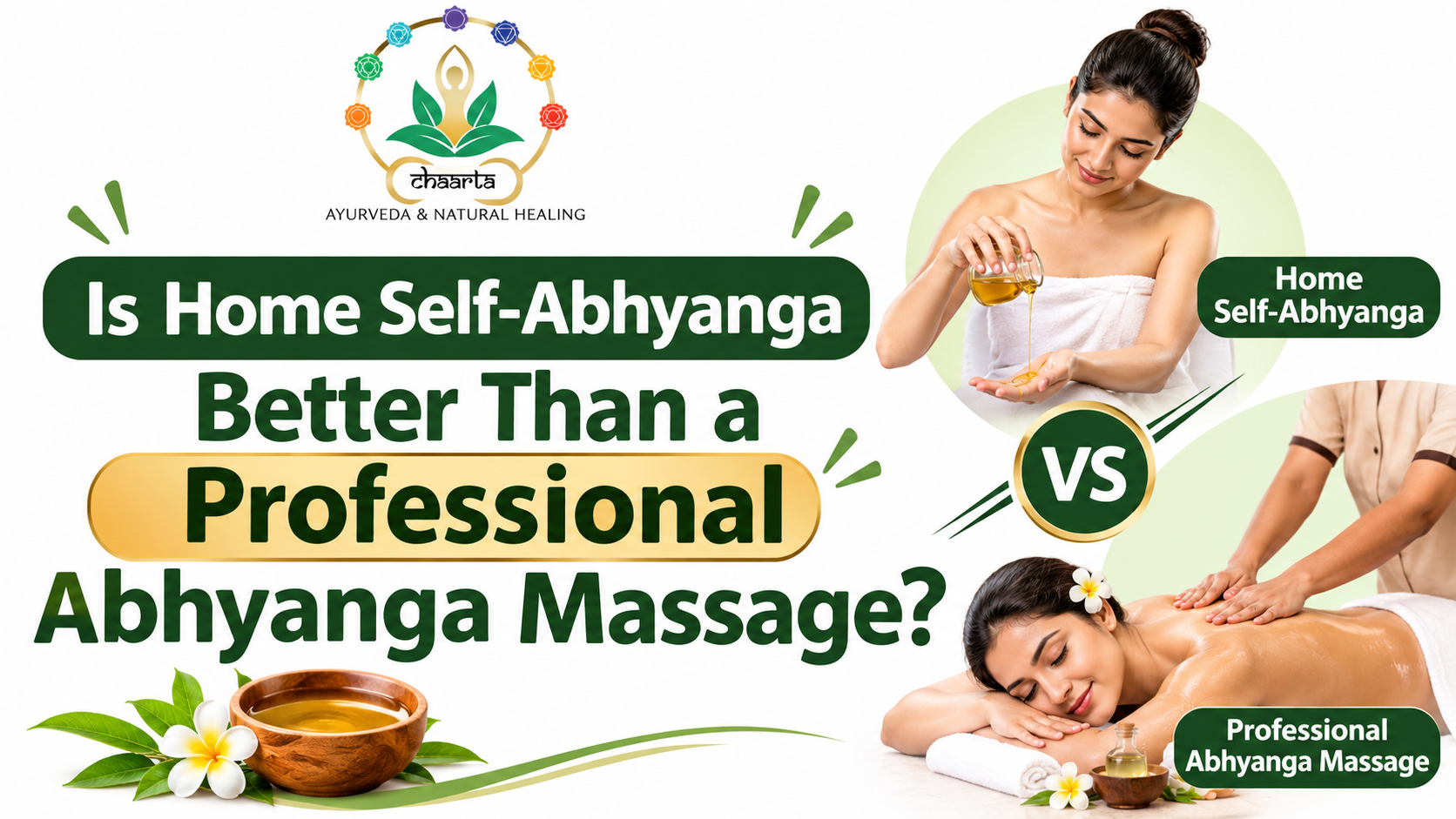
The regular hustle and bustle in life can make it quite difficult for you to relax your mind and body for a while. This is exactly where Abhyanga can play a pivotal role in providing you with measurable relief. Basically, this is associated with providing measurable relief and a noticeable reduction in joint pain and anxiety. Ayurvedic practitioners have precise knowledge regarding pressing your specific joints, as a result of which you can experience relaxation. Using medicated and herbal oils is highly preferred, letting you feel physically relaxed and emotionally balanced. When you understand what factors differentiate Abhyanga at home vs. professional massage, then you get to know which one would be better for you.
Self-abhyanga massage or choosing a professional space to undergo this massage procedure entirely depends on your specific purpose and therapeutic depth. Both styles have specific differences, which you must be aware of. To learn about them, continue reading this blog till the end.
First, understand what Abhyanga massage means.
For maintaining a healthy mind and body, choosing Abhyanga massage would be a suitable option, associated with the ancient wellness of Ayurveda. With the use of herbal-infused oil, the experts make sure to balance your aggravated doshas, Vata, Pitta, and Kapha, along with enhancing blood circulation.
Which oil is selected for Abhyanga massage?
Oil selection for Abhyanga massage depends on the specific doshas that are aggravated, along with the season, to choose and use the right oil.
For Vata dosha: Using sesame oil would be a better option in terms of providing moisture to the skin and dealing with dryness.
For Pitta dosha: Calming Pitta dosha requires coconut and sunflower oil, as both include cooling effects to manage its aggravation.
For Kapha dosha: Mustard and grapeseed oil are usually the best choice for managing the heaviness and oiliness that is associated with Kapha dosha.
For particular seasons: Using the lighter oils for the summer days and the heavier oils for the cooler days generally provide exceptional therapeutic benefits.
Here’s the comparison between home Abhyanga massage and a professional setting!
What does home Abhyanga massage include?
- Targeting your daily exhaustion with the aim of calming down your nervous system includes the practice of performing Abhyanga at home.
- Self-Abhyanga allows you to be in your own comfortable environment while massaging with the chosen oil.
- During Abhyanga at home, individuals prefer opting for sesame and coconut oil to relax themselves.
- You can start by gently nourishing your ears, knees and chest in your own space.
What are its benefits?
- Choosing Abhyanga on a regular basis helps promote good sleep while relaxing your mind.
- It can be done at home, which apparently sounds inexpensive for many.
How does its meaning change when performed by the experts?
- Abhyanga in a professional space generally means providing therapeutic relief from everyday struggles.
- Your joint pain and stiffness can also be addressed through this technique.
- The experts do not use a single medicated oil for each individual; in fact, they understand that each individual requires a different oil to provide deep therapeutic relief.
- From your scalp to your knees and joints, you have been provided with a gentle massage to relieve your pain and stiffness.
What are its benefits?
- The experts understand the use of different oils, which are beneficial for targeting chronic conditions, and choose them according to the specific dosha and the individual's needs.
- Even for venting emotional grudges, the experts are well aware of the specific points to make it easier.
- Usually, this massage is done by two therapists or one, providing you with deep relief that cannot be achieved during self-abhyanga.
- With the right technique of massaging muscles and joints in a circular motion, the muscle stiffness gets better.
Which abhyanga style would be better for you?
- If you often get exhausted from your everyday struggles, then choosing home-style Abhyanga would benefit you in terms of providing relaxation.
- However, if your concern is joint pain and stiffness along with getting therapeutic relief, then professional space Abhyanga would be a suitable choice for you.
The Bottom Line!
Although both the Abhyanga styles can provide you with measurable relief from your everyday stress and exhaustion. Being particular about your therapeutic goals can simplify choosing between the two for yourself.
If you have been dealing with stressful days constantly along with joint pain and stiffness, then be sure to engage with your Ayurvedic therapists for Abhyanga with the aim of experiencing inner relief and relaxation. We, the experts at Ananta Ayurveda, include Abhyanga massage, ensuring better sleep along with a relaxed nervous system. Our expert, Geetanjali Kansal, makes sure that the therapists coordinate well with each other so that patients with their specific concerns get measurable relief.
Frequently asked questions.
Which chronic conditions are targeted with the help of Abhyanga?
Different musculoskeletal disorders, along with joint pain and stiffness, can be addressed through Abhyanga; insomnia and anxiety are on the list too.
Who must avoid getting an Abhyanga massage?
People struggling with indigestion or other digestive issues, along with pregnant women and those suffering from fever and chills, must avoid an Abhyanga massage.
What are the crucial things that must not be done after an Abhyanga massage?
After getting an Abhyanga massage done, ensure you keep yourself away from heavy physical activities that might exhaust you; along with this, avoiding cold and fried food options must be prioritised as well.
When is the best time to go for an Abhyanga massage?
The best time for an Abhyanga massage is early morning or on an empty stomach to experience relaxation.